Peptides and chronic conditions in 2026: what the research says

The short answer
Several peptides, most prominently BPC-157, KPV, and thymosin alpha-1, are being studied for effects on gut and immune pathways, but the human evidence is limited and none is an approved treatment for any disease. Much of the gut data for BPC-157 and KPV comes from rat and mouse models rather than people. For long COVID specifically, no peptide is an established treatment: the largest coordinated NIH long-COVID trial program did not select any of the peptides marketed for gut and immune health among its first interventions. Side effects are well described only for thymosin alpha-1, so the honest next step is a supervised conversation about your goal rather than a hunt for a specific molecule.
If you are managing a chronic gut or immune condition and have run into peptides online, you have probably also run into a lot of confident promises. The claims are loud, the sourcing is thin, and the part that actually matters, how strong the evidence really is and what is known about side effects, tends to get skipped. This page is the opposite of that. It walks through what the research on the most-discussed peptides actually shows, names the evidence level honestly, and covers what people are saying about them online. Every factual claim below is tied to a primary source.
The short version is worth stating up front, because it reframes the whole question. For a chronic condition, the useful decision is not “which peptide should I buy?” It is “what does a licensed clinician think is appropriate for my goal?” The molecules people search for are, for the most part, still early-stage science. A good provider starts from your condition and your labs, not from a product.
Are peptides a treatment for chronic gut or immune conditions?
No. None of the peptides commonly marketed for gut and immune health, including BPC-157, KPV, and thymosin alpha-1, is an approved treatment for any disease, and the human evidence behind them is limited. They are being studied for effects on inflammatory and immune pathways, which is a very different statement from “they work for your condition.” Much of what circulates online quietly upgrades “studied in a mouse” into “treats your illness,” and that upgrade is not supported by the data.
That distinction is the single most important thing to hold onto on this page. A substance can have a plausible mechanism, promising animal results, and real scientific interest, and still not be something a clinician can responsibly present as a therapy. For a chronic condition specifically, the gap between an interesting mechanism and a proven treatment is exactly where people get hurt, medically and financially.
What does the research on BPC-157 and the gut actually show?
The BPC-157 gut evidence comes almost entirely from animal studies, chiefly in rats. BPC-157 is a synthetic peptide that has been investigated for effects on the gastrointestinal lining, on ulcer and surgical-anastomosis models, and on markers of inflammation, and a 2024 review in Pharmaceuticals summarizes this body of work as being conducted in rat models of conditions such as colitis, short bowel syndrome, and intestinal fistulas. The animal signal is consistent across research groups, which is genuinely interesting, but it is animal data.
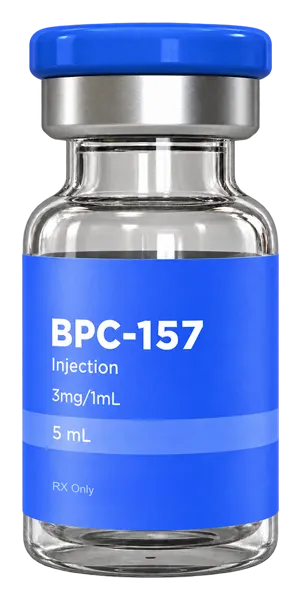
Human evidence is thin. BPC-157 was carried into early-phase inflammatory bowel disease research under development codes including PL 14736 (Pliva, Croatia), and a 2007 study in Surgery Today notes it was reported as safe in those early trials while the experiment itself was, again, a rat study. What does not exist is a completed, large, controlled human trial demonstrating that BPC-157 works for a specific gut disease. So the accurate summary is: promising preclinical mechanism, preliminary human safety signal, no proven clinical efficacy, and no approval by the FDA. You can read the fuller breakdown on our BPC-157 and gut health evidence page.
What is KPV, and what has it shown for intestinal inflammation?
KPV is a three-amino-acid fragment (lysine-proline-valine) taken from the tail end of alpha-melanocyte-stimulating hormone, and its intestinal research is at the mouse-and-cell stage. In a study published in Gastroenterology (Dalmasso and colleagues), orally administered KPV lowered the severity of two standard chemically-induced colitis models in mice and reduced inflammation markers, and the authors traced the effect to uptake through the intestinal peptide transporter PepT1 into epithelial and immune cells. Their conclusion framed KPV as a candidate worth studying for inflammatory bowel disease, not as an available therapy.
That is the honest ceiling of the KPV evidence today: encouraging anti-inflammatory activity in animal and laboratory models, a plausible transport mechanism, and no completed human trials establishing it as a proven therapy for inflammatory bowel disease or “leaky gut.” Anyone presenting KPV as a settled answer for a human gut condition is describing a hope, not a result. Our KPV and inflammation explainer covers the mechanism in more depth.
Is thymosin alpha-1 studied for immune conditions, and is it approved in the US?
Thymosin alpha-1 is a naturally occurring immune-signaling peptide that has the most human research of the three, but it is not approved by the FDA in the United States. A comprehensive review in the World Journal of Virology describes its immune-modulating action, including effects on T-cell populations and dendritic cells through toll-like receptor signaling, and notes that its synthetic form, thymalfasin (brand name Zadaxin), is approved in more than 35 countries for hepatitis B and C, with additional study in sepsis and certain cancers. So there is a real clinical literature here, mostly generated outside the US.
For a US reader, the key fact is that thymosin alpha-1 is a marketed medicine elsewhere but is not FDA-approved in the United States. It is being studied for immune modulation; it is not an established US treatment for autoimmune disease, chronic infection, or any other condition. Our thymosin alpha-1 and immune modulation page lays out the clinical studies and their limits.
Are peptides a treatment for long COVID?
No peptide is an established treatment for long COVID, and this is the clearest example of the gap between online marketing and actual evidence. The most direct signal comes from where the serious research money is going: the NIH’s coordinated long-COVID treatment program, RECOVER-TLC, selected its first clinical-trial interventions and they are baricitinib, a GLP-1 receptor agonist (semaglutide), low-dose naltrexone, and stellate ganglion nerve block, as summarized by the RECOVER COVID Initiative. None of the peptides marketed for gut and immune health, BPC-157, KPV, or thymosin alpha-1, made that initial list. (Semaglutide is itself a peptide, a GLP-1 receptor agonist, but it is a metabolic medicine, not one of the peptides sold to people managing chronic gut or immune conditions.)
That absence is informative. When the largest, best-funded long-COVID trial effort in the country builds its first arms, and none of the gut-and-immune peptides people are marketed is among them, it tells you the evidence for those peptides in this condition is not yet strong enough to prioritize. Individual peptides such as thymosin alpha-1 have mechanistic rationale and small early studies, but mechanistic rationale is not proof of benefit, and there is no peptide you can point to as a demonstrated long-COVID therapy in 2026. The most honest thing a source can tell a long-COVID patient about peptides is that this remains an open research question, and our long-COVID and peptides review says exactly that.
What is known about side effects?
The side-effect picture tracks the evidence picture: the more a peptide has been studied in people, the more is known.
- Thymosin alpha-1 has the clearest record. A comprehensive review describes the synthetic form, thymalfasin, as “usually well tolerated,” with local irritation, redness or discomfort at the injection site as the most common effects. Because it acts on the immune system, the same review lists it as contraindicated in immunosuppressed patients such as organ transplant recipients unless the benefits outweigh the risks, which matters for anyone with an autoimmune condition on immune-suppressing drugs.
- BPC-157 has almost no human safety data. A 2025 review of the human literature found only three small published human studies and noted “limited data regarding safety and associated side effects,” along with theoretical concerns such as unwanted blood-vessel growth, since the peptide turns up growth signals like VEGF in animal studies.
- KPV has no human safety data at all, because it has not been tested in people.
For someone managing a chronic condition and often taking other medicines, “unknown” is itself the most important side-effect fact here.
Why does physician supervision matter most for a chronic condition?
Your baseline is already different from a healthy person’s. You may be on other medications, your immune system may already be suppressed or overactive, and a new substance whose interactions have not been studied is exactly the scenario where things go wrong quietly. Product quality is a separate unknown: peptides sold as “research use only” are, by that label, not made or tested to medicine standards.
A licensed clinician evaluates your history, symptoms, and labs, and recommends what is appropriate for your situation, which is often not a peptide at all but an evidence-backed option for your condition. The honest trade-off is worth naming: an appropriate treatment is never promised in advance, and a good provider may steer you away from the molecule you came in asking about. What supervision offers instead is accurate information and monitoring.
What are people saying about these peptides?
Online conversation about gut and immune peptides is dominated by personal experiments, not trials. Our Community Insights summaries analyzed public posts on X in July 2026 (16 posts about BPC-157 for this site, July 16 to 20; 13 posts about thymosin alpha-1, July 9 to 16); the themes below summarize that discussion and are anecdotes, not evidence.
- BPC-157 for leaky gut. Several posters describe taking oral BPC-157 to repair the gut lining, often pointing to its stated origin in gastric juice; they do not agree on how much it helps.
- A contested BPC-157 safety signal. One poster reports roughly 20 self-reported cancer-like adverse events and points to VEGF activity, while stressing nobody knows how many people used it; others call it cheap and low-risk.
- Thymosin alpha-1 as a “don’t get sick” peptide. A few commenters describe it as a daily staple and credit it with heading off colds, one recounting staying well on a cruise while others fell ill. These are individual stories, not a pattern from a study.
- Thymosin alpha-1 and its approved-abroad status. Users note it is approved in many countries as Zadaxin and say they seek it out off-label for immune and antiviral purposes.
An evidence summary you can screenshot
The table below is the whole page in one view: what each peptide is studied for, how strong that evidence is, and what is known about side effects in people.
| Peptide | What it is studied for | Strongest evidence level today | Side effects known in people |
|---|---|---|---|
| BPC-157 | Gastrointestinal lining, ulcer and anastomosis models, gut inflammation | Mostly rat/animal models; a preliminary human safety signal from early IBD research (PL 14736); no completed controlled efficacy trial | Largely unmeasured; three small human studies in total |
| KPV | Intestinal inflammation (colitis models) | Mouse colitis models and cell studies; no completed human trials | None measured; no human studies |
| Thymosin alpha-1 | Immune modulation (studied in hepatitis, sepsis, some cancers) | Human trials, largely outside the US; approved as thymalfasin in 35+ countries but not approved by the FDA | Usually well tolerated; injection-site irritation most common; caution with immune suppression |
Two honest takeaways from that table. First, the evidence level rises as you move down the list, but even the strongest case (thymosin alpha-1) is a medicine approved elsewhere and not in the US, not a proven answer for the conditions people ask about. Second, side-effect knowledge follows the same order, from “well characterized abroad” to “never measured.” That is why this page ends where it does, with your goal rather than a molecule.
What a licensed provider can do for your goal today
A licensed provider can start from your condition and offer the appropriate options that fit it. If your goal is calmer gut symptoms, better immune resilience, or a clearer plan for a post-viral condition, the productive move is to bring that goal to a clinician who can evaluate you, order labs where useful, and recommend what is appropriate, which may be an established therapy rather than a peptide. An appropriate plan is decided case by case; no legitimate service can promise a particular outcome or a particular prescription in advance. For the questions worth bringing to that conversation, see questions to ask your doctor about peptides.
That is the genuinely useful version of “peptides and chronic conditions in 2026.” The science is worth following, the marketing is not worth trusting, and the safest path runs through a real evaluation.
You may also want to read what the research on BPC-157 and gut health shows, how thymosin alpha-1 is studied for immune modulation, and whether peptides are a treatment for long COVID.
Status: BPC-157: Not FDA-approved; sold by some telehealth providers as a compounded prescription. An FDA advisory committee reportedly voted in July 2026 to recommend allowing pharmacies to compound it; nothing has changed yet. Thymosin alpha-1: Not FDA-approved; sold by some telehealth providers as a compounded prescription. KPV: Not FDA-approved. What these status terms mean.
2026 update and sources
None of the peptides discussed here is an approved treatment for any disease in the United States. The research summary reflects sources checked in July 2026, and the status line reflects the network status page as of October 12, 2026. Nothing here is medical advice; it is a plain-English, sourced summary of the current evidence.
Primary and authoritative sources used on this page:
- Dalmasso et al., Gastroenterology, PepT1-mediated tripeptide KPV uptake reduces intestinal inflammation (mouse and cell study)
- Bajramagic et al., Pharmaceuticals (2024), BPC 157 and intestinal anastomoses therapy in rats: a review
- Vuksic et al., Surgery Today (2007), BPC 157 (PL 14736) inflammatory bowel disease trials; ileoileal anastomosis study in rats
- Dominari et al., World Journal of Virology (2020), thymosin alpha 1: a comprehensive review of the literature
- RECOVER COVID Initiative, mid-2026 progress, including the RECOVER-TLC clinical-trial interventions
- McGuire et al., Current Reviews in Musculoskeletal Medicine (2025), Regeneration or risk? A narrative review of BPC-157
Sources (6)
Advertising disclosure: links marked "Paid link" go to Bodybuilding Peptides (trybbpeptides.com), an affiliate destination, and Gut & Immune may earn a commission if you buy there. Our coverage is independent of that relationship, and nothing on this page is medical or legal advice.
 See it at Bodybuilding Peptides